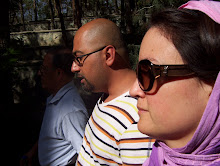
On Tuesday my husband and I visited the college apartment of A. It was a bona fide bachelor pad, where our friend carved out a little niche in the living room for his desk, folders, various personal items, and his Gohonzon. He had just taken a midterm that day and was anxious about it, and riding back home from it he "took a spill" on his bike in the pouring rain and landed hard on cement. We discussed how important it was to chant for something specific in mind, more than just "wisdom" as he put it, because that helped him chant with more resolve. Amidst his studies, work, Buddhist club activities on campus and social life he somehow fits in Rock the Era activities.
Today I strolled my baby a mile to M.'s house, which is right on the green belt bike path. She began chanting after her mother, a retired judge, began practicing ten years ago in the Bay Area. M. talked about how she wanted more motivation to chant, and we decided to visit some Buddhist members together to kick start our big dreams for the future and open up more possibilities.
Tonight I took the youngest member of our district, my one-year-old daughter, to visit the most senior member. E. is ninety years old and is the niece of the great Eleanor Roosevelt. Her daughter and caretaker were also there to chant along with us. After chanting she kept saying how much she loved the baby.
I thought I would do some yoga tonight but I'm just too tired.
Thursday, February 25, 2010

Tuesday, February 23, 2010
Yesterday afternoon I visited M. at her quaint apartment in West Davis. She invited me in to her immaculate room, with all her books and various sundries neatly stacked on a shelf. Tiny florescent post-it notes enlivened the space above her computer. A humble black Buddhist altar sat at the center of the room, and below it, a list of goals she was chanting for. We talked about her future plans for the next year, and what she wants to do when she graduates UC Davis. I asked her why she recently started chanting, and she told me about her boyfriend who told her if she tried chanting she would "become happy." Though she was previously a Christian, she said that she had never heard a religion promise to make people happy and that intrigued her. We also discussed the upcoming "Rock the Era" celebration in L.A. I realized while encouraging her to participate I knew very little about it. All I could say was that based on experience, it was something she wouldn't want to miss!
Sunday, February 21, 2010
This morning I travelled 13 miles east of Davis through acres of farmlands before reaching my destination--the sleepy town of Winters. There I met C. at her lovely Victorian farmhouse, renovated for the modern family with high ceilings, hardwood floors, and a fine animal entourage of a cornfield snake and a turtle. Next to her family's house was a grand church built probably around the same time, late nineteenth century. A menacing orange tree weighed down by the winter's bounty separated her and the church. We sat and talked, and did some Buddhist chanting for over an hour. I felt refreshed.
Friday, July 10, 2009
The Audacity of Nope
Ali Shariati, arguably one of the most important ideologues of the 1979 Iranian revolution, once stated that Iran's Shii political tradition is predicated on the word "no." He invoked the beginnings of the Shi'a-Sunni disagreement when the family of Ali, the seventh-century fourth caliph and cousin of the Prophet Muhammad, was surreptitiously denied successorship of the Muslim community. Social justice, therefore, was every Muslim's right, and the refusal to accept corrupt authority was an obligation.
Today's protests are not rooted in religion per se but the politics of "no"--no to trumped-up election results, no to top-down authority, no to cronyism, no to state-enforced morality. Shariati's ghost haunts the current government because the country now boasts a one-hundred-year tradition of populist uprisings.
In the twentieth century, Iranians fought for change from every corner of society, from the streets to the pulpit, the local coffeehouse to the coffeehouses of Europe. The Constitutional Revolution of 1905, Mossadegh's nationalist moment (before the U.S. and British -backed coup of 1953), and the 1979 revolution were all protest movements with a formidable populist base. In every above instance including the current uprising--which Hamid Dabashi has rightly called a "civil rights movement" and not a revolution--societal forces across gender, class and ethnic lines have sprightly mobilized against autocratic government. (The byword of the constitutional revolution, in fact, was "anti-depotism" (zed-e estebdad)).
From the vantage point of history's longue durée, the thirty-year time lapse between 1979 and now is relatively short. The fact that we see two major social upheavals within this period is a testament to the political gumption of two main demographics--the post-WWII generation, and now the post-1979, post-Iran-Iraq war baby boomers. The latter group has been weened on the memory and political symbolism of their parent's coup, and though many including myself underestimated their frustrations as youthful angst, recent events show they have reached a high level of political maturity. Though still in a process of defining themselves, they have appropriated the 1979 generation's playbook, using anti-Shah slogans ("Death to the dictator!"), nighttime ritual chants on rooftops ("Allahu Akbar!"), coming out in vast numbers at memorial gatherings, and even practical knowledge such as how to puncture the motorcycle tires of militia groups.
The heroic participation of Iranians citizens in their political fate embodies the audacity of nope. More importantly, today's grassroots movement appears de-centered. Whereas in '79 Ayatollah Khomeini was the preeminent refusenik, today's symbolic icon is an innocent by-standard known simply as "Neda." The new face of protest is not a Khomeini or even a Moussavi, but an ordinary young woman. These days I throw caution to the wind, so at the risk of sounding overly romantic, let me just say that while you can remove Moussavi, there will be a million Nedas to rise up and take his place.
Iranians have risen time and again to demonstrate what they don't want. Now the world awaits a clear picture of what it is they do. For now, their refusal is, as a colleague put it, a "manifestation of change itself."
Today's protests are not rooted in religion per se but the politics of "no"--no to trumped-up election results, no to top-down authority, no to cronyism, no to state-enforced morality. Shariati's ghost haunts the current government because the country now boasts a one-hundred-year tradition of populist uprisings.
In the twentieth century, Iranians fought for change from every corner of society, from the streets to the pulpit, the local coffeehouse to the coffeehouses of Europe. The Constitutional Revolution of 1905, Mossadegh's nationalist moment (before the U.S. and British -backed coup of 1953), and the 1979 revolution were all protest movements with a formidable populist base. In every above instance including the current uprising--which Hamid Dabashi has rightly called a "civil rights movement" and not a revolution--societal forces across gender, class and ethnic lines have sprightly mobilized against autocratic government. (The byword of the constitutional revolution, in fact, was "anti-depotism" (zed-e estebdad)).
From the vantage point of history's longue durée, the thirty-year time lapse between 1979 and now is relatively short. The fact that we see two major social upheavals within this period is a testament to the political gumption of two main demographics--the post-WWII generation, and now the post-1979, post-Iran-Iraq war baby boomers. The latter group has been weened on the memory and political symbolism of their parent's coup, and though many including myself underestimated their frustrations as youthful angst, recent events show they have reached a high level of political maturity. Though still in a process of defining themselves, they have appropriated the 1979 generation's playbook, using anti-Shah slogans ("Death to the dictator!"), nighttime ritual chants on rooftops ("Allahu Akbar!"), coming out in vast numbers at memorial gatherings, and even practical knowledge such as how to puncture the motorcycle tires of militia groups.
The heroic participation of Iranians citizens in their political fate embodies the audacity of nope. More importantly, today's grassroots movement appears de-centered. Whereas in '79 Ayatollah Khomeini was the preeminent refusenik, today's symbolic icon is an innocent by-standard known simply as "Neda." The new face of protest is not a Khomeini or even a Moussavi, but an ordinary young woman. These days I throw caution to the wind, so at the risk of sounding overly romantic, let me just say that while you can remove Moussavi, there will be a million Nedas to rise up and take his place.
Iranians have risen time and again to demonstrate what they don't want. Now the world awaits a clear picture of what it is they do. For now, their refusal is, as a colleague put it, a "manifestation of change itself."
Subscribe to:
Posts (Atom)